
'The perception of colour is an experience common to almost all sighted humans. Yet in the West colour has often been regarded as trivial or disruptive, and as 'unworthy of series regard'
What might be at stake in this denigration of chromatic experience?

Since Newton discovered “pure white sunlight”,1 that the “gift from god”2 could be “broken down”3 or “created by mixing coloured lights together”4 people have been asking the question - What is the colour of colours? I would like to specify my definition of the word “colour” here is everything but black white and grey.
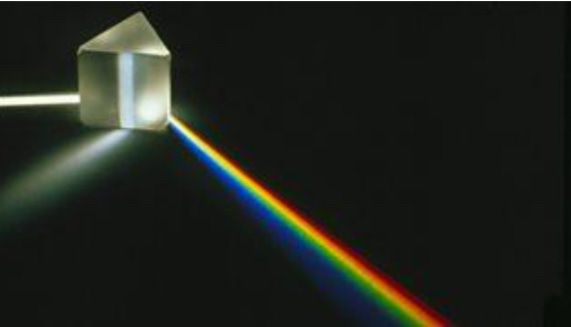
5
David Batchelor realising that he “hadn’t written a book about colour: [he] had written a book about ideas about colour.”6 reveals how difficult it is to describe the experience of colour. I will explore how this affects how we regard colour and its consequences, our inability to express colour within language demonises it. Colour infuriates people, it’s just out of reach despite its expansiveness and words never perfectly describe it. As language and writing are a symbol of education in the West, colour is often disregarded. It’s (to people’s dismay) untouchable, fleeting, transient and unable to be captured like a taste, smell or touch can. In conjoining colour to a page with words made from humans by humans, we are not truly understanding it. In response, I will be looking at different media where colour is/isn’t directly discussed. If you lose colour, you lose hope. Try to understand colour through the laws of physics, or religion and you lose reality, so, I will not attempt to unravel colour’s secrets. I will write about how colour makes us feel, and how categorising colour disables
1 Warrell, Ian. The Secret Lives of Colour. Country Life (London), 2017, 90. – [Page 19] 2 Warrell, Ian. The Secret Lives of Colour – [Page 19]
3 Warrell, Ian. The Secret Lives of Colour – [Page 19]
4 Warrell, Ian. The Secret Lives of Colour – [Page 19]
5 [Figure 1], BBC Bitesize, Light being refracted through glass. https://www.bbc.co.uk/bitesize/guides/zdx4t39/revision/3 (Accessed 01/05/2023)
6 Batchelor, David. The Chromatic Ecology of Munchkin Land. ((1st year lecture, adapted from Professorial Inaugural Lecture, Goldsmiths’ College, 25.02.19). (Accessed 12/ 04/2023) – [Page 1]
any chance for us to simply exist within the world we know. In this essay, I will be explaining how by denigrating the chromatic experience and segregating black and white from colour, and regarding colour as unessential we are at stake of risking our understanding of colour even further. By validating colour via human laws of acknowledgement, we stray further from it.
7
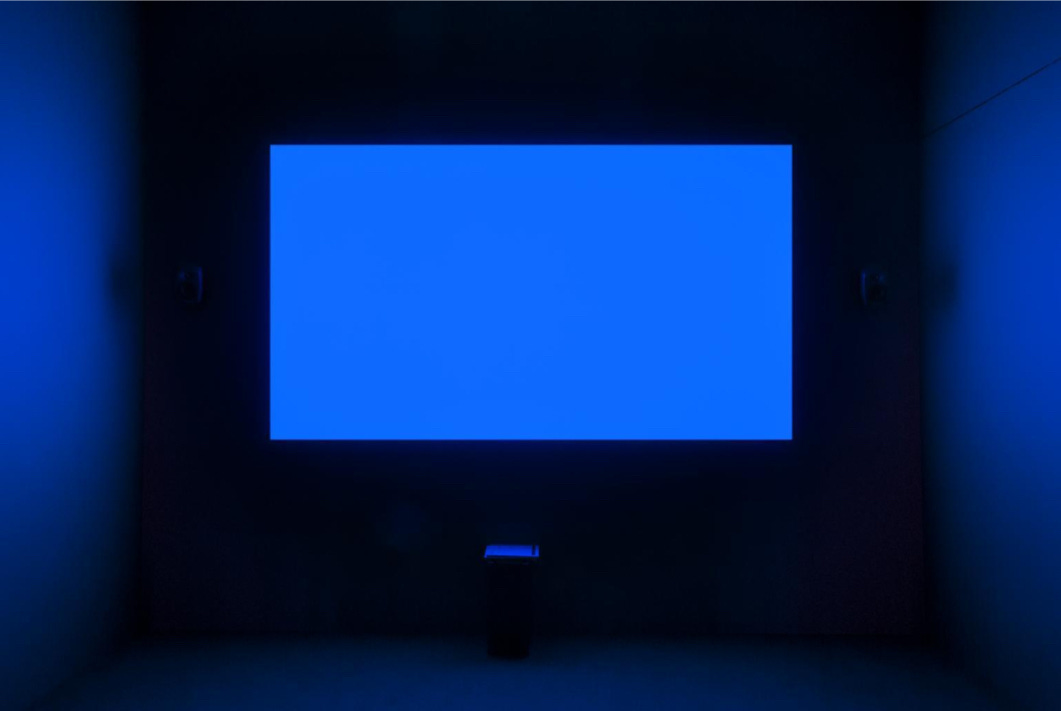
How would accept that you would only see one opaque colour for the rest of your life? How would you fare watching it consume the “10 million different hues”8 you used to see. This was Derek Jarman’s reality when he lost his vision to AIDS, overwhelmed by the Blue9. What’s remarkable to me is that Jarman never tried to understand what “blue” really is in the film. The reality is, it simply does not matter in the face of death. He simply has to perceive it. This film shows how colour cannot
7 [Figure 2] Jarman, Derek, Picture of Film being exhibited in The Tate, 2014, https://www.tate.org.uk/art/artworks/jarman-blue-t14555 (Accessed 01/05/2023) 8 Batchelor, David. The Chromatic Ecology of Munchkin Land – [Page 1]
9 Jarman, Derek. Blue. Basilisk Communications/Uplink, 1993.
be seen as “the fragility of the temporary”,10 for Jarman, blue is the “stability of death.”11 Blue is one of the only texts where language is as truthful as it can be when documenting colour, not through the metaphors or descriptions but the sheer overwhelming number of times we have to confront Jarman’s blue. We have to accept that “Blue is”12 whatever Jarman says it. Nobody saw this blue but Jarman, engulfing him in a way we will never understand. The only window we have is a film showing a blue screen. The real colour comes with the sound and text. As I have mentioned earlier, the reason the West perceives colour so negatively is precisely because we can perceive it but not fully express it, we humanise it via language and barricade ourselves from its limitlessness. I feel Jarman understood this; he mentioned: “if the doors of Perception were cleansed13 then everything would be seen as it is.”14 He’s hopelessly aware that he will never understand the one thing he sees and in response, he does the only thing he can do - describes it. Jarman walks “along the beach in a howling gale” or a “blue frost”, he names blue “ultramarine”, “lapis” “aqua vitae”.15 He knows he will never be free of humanity, his identity, and what’s shaped him just as he will never be free of “Blue”, and instead of fighting this he desperately tries to translate human experience into writing, but no word encapsulates it. Hence the time he spends repeating the word - ritualising it. he “opens his eyes”16 into blue, birthed into it. We hear chants beckoning blue to enter him, as a boy, as a man; “O blue come forth, O Blue arise, O Blue ascend, O Blue come in.” Blue is a love letter to where humanity stands short. A plea for humanity to understand how colour “transcends the solemn geography of human limits”17 or the “wine dark sea”18 will drown/blind us. “Colour will leave us”19 if we only see its validity when analysed through the human eye.
10 Batchelor, David. The Chromatic Ecology of Munchkin Land – [Page 6]
11 Batchelor, David. The Chromatic Ecology of Munchkin Land – [Page 7]
12 Jarman, Derek. “Blue”. 1993
13 Wu, Duncan. Romanticism an Anthology. 4th ed. Blackwell Anthologies. The Marriage of Heaven and Hell | William Blake. Chichester, West Sussex : Malden, MA: John Wiley & Sons, 2012.
14 Jarman, Derek. “Blue”. 1993
15 Jarman, Derek. “Blue”. 1993
16 Jarman, Derek. “Blue”. 1993
17 Jarman, Derek. “Blue”. 1993
18 Jarman, Derek. “Blue”. 1993
19 Batchelor, David. The Chromatic Ecology of Munchkin Land – [Page 5]

20
This “wine-dark sea”21 leads me to believe we should have fewer colour names. To the Ancient Greeks colour was a spectrum and “frequently referred to the shade of tint of a hue instead.”22 “Wine dark sea” was used as there was no word for blue. In most languages “Black and white are the most ancient [named] colours.”23 Meaning, every named colour that we know could be perceived within just black and white. For some, this is an “enormous asymmetry between what we can see and what we can say”24 as our “eleven basic colour terms”25 are often seen as lacking due to the
20 [Figure 3] Seattle Artist League, Picture of the ‘wine-dark sea’, 10/09.2018 https://www.seattleartistleague.com/2018/10/09/the-wine-dark-sea/ (Accessed 01/05/2023)
21 Homer. The Odyssey. Translated by Robert Fagles. Boyle.Kyschools.https://www.boyle.kyschools.us/UserFiles/88/The%20Odyssey.pdf (Accessed 01/05/2023) – [Page 8]
22 Wichmann, Anna. Did the Ancient Greeks See Blue Like We Do? GreekReporter. 25/04/2023. https://greekreporter.com/2023/04/25/did-ancient-greeks-see- blue/#:~:text=Linguists%20argue%20that%20ancient%20Greeks,exactly%20they%20perceived%20the%20hue. (Accessed: 25/04/2023)
23 Wichmann, Anna. Did the Ancient Greeks See Blue Like We Do? 25/04/2023
24 Batchelor, David. The Chromatic Ecology of Munchkin Land – [Page 2]
25 Batchelor, David. The Chromatic Ecology of Munchkin Land – [Page 2]
millions of different hues we can see. However, I believe the opposite. I have discussed how describing colour is one of the reasons why we segregate them, and while I know humanity can never escape this due to our “infantile wonder at undiluted colour”26, I believe by having fewer terms for colour, the less we are at risk of never truly understanding colour.
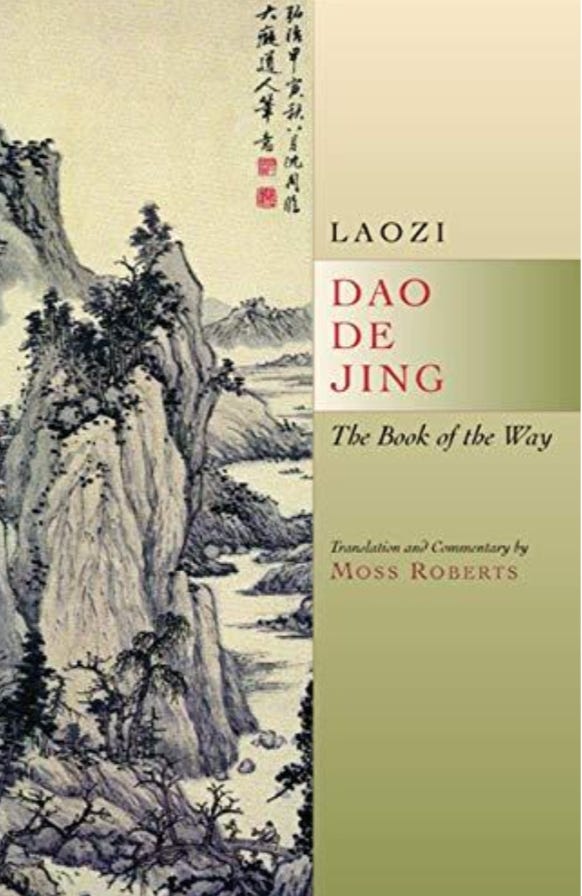
27In the verses of Dao De Jing, we learn “there are already enough names. One must know when to stop”28, otherwise we will become ‘blind’.29 In order to genuinely perceive colour, despite our one- dimensional perspective, we must learn that “it is unfathomable, all we can do is describe”30 it. If you deem colour as “unworthy of series regard”31 you will no longer be able to see colour, only the residues of human opinions and interferences, finally, “colour will leave us”.32 Colour is in everything, perhaps scientifically shadow and light aren’t colour but the human eye perceives colour within them. To deny this is to risk denying the very makeup of
26 Batchelor, David. The Chromatic Ecology of Munchkin Land – [Page 3-4]
27 [Figure 4] Laozi, Dao De Jing, Cover from the University of California Press (31 Oct. 1997) Ver. Translated by Moss Roberts. https://www.amazon.co.uk/Dao-Jing-Book-Moss-Roberts/dp/0520242211 (Accessed 1/05/2023)
28 Laozi, Feng, Gia-Fu & Jane English, trans. Dao De Jing. New York, NY: Vintage Books, 1989. http://www2.hawaii.edu/~freeman/courses/phil394/Daodejing.pdf. (Accessed 14/04/2023) – [Page 11, Passage 32]
29 Laozi. Dao De Jing. 1989 translation – [Page 4, Passage 12]
30 Laozi. Dao De Jing. 1989 translation – [Page 5, Passage 15]
31 Reynolds, Joshua. Morley, Henry. The Project Gutenberg eBook, Seven Discourses on Art, by Joshua Reynolds. Transcribed from the 1901 Cassell and Company edition by David Price. eBook #2176. 08/05/2005. (Accessed 02/05/2023)
32 Batchelor, David. The Chromatic Ecology of Munchkin Land – [Page 5]
our perception of Earth. If nature “paints like a harlot”3334, it is not simply to “seduce us but to protect us”35 and perhaps we are the fools for submitting to this harlot. If you live in black and white, the excess(colour) also exists, in exiling something you can never truly deny it; “From above it is not bright; From below, it is not dark”.36
So, where does this affinity for black and white over colour come from? Why is it almost “taboo”37 to 38consider them the same? And why is colour by itself “weak and unworthy of regard”?39 “Chromophobia”40 has been around for centuries, the belief that “To be civilized is to eschew colour, to resist it”41 comes from the idyllic vision of pure white light. “Pure white”,42 and its mirror, pure “darkness”43 are the flags for generations of marginalising colour as “a corruption, a lapse, a fall”.44 This Puritan belief of the “distraction”45 of colour contrasts with modern insight into colour and how we are drawn to it to align with our true selves.
33 Melville, Herman. Moby Dick. Anaheim, CA: Cyber Classics. (Accessed: 16/04/2023) – [Page 193]
34 Warrell, Ian. The Secret Lives of Colour – [Page 34]
35 Batchelor, David. Chromophobia. Focus on Contemporary Issues. London: Reaktion, 2000. (Accessed 12/04/2023 – [Page 10]
36 Laozi. Dao De Jing. 1989 translation – [Page 5, Passage 14]
37 Warrell, Ian. The Secret Lives of Colour – [Page 20]
38 [Figure 5] Posh Paint, Pure White No.1, https://www.poshpaint.com/product/pure-white-no-1/ (Accessed 01/05/2023)
39 Reynolds, Joshua. Seven Discourses on Art. 08/05/2005
40 Batchelor, David. Chromophobia. 2000 – [Page 12]
41 Jennings, Carl. Chromophobia: Men In Black - The Fear of Colour in Western Culture. Medium. 05/25/2019. https://medium.com/swlh/men-in-black-the-fear-of-color-in-western-culture-33e42a5e92c2. (Accessed 15/04/2023)
42 Warrell, Ian. The Secret Lives of Colour – [Page 19]
43 Warrell, Ian. The Secret Lives of Colour – [Page 267]
44 Batchelor, David. Chromophobia. 2000 – [Page 12]
45 Warrell, Ian. The Secret Lives of Colour – [Page 34]
46
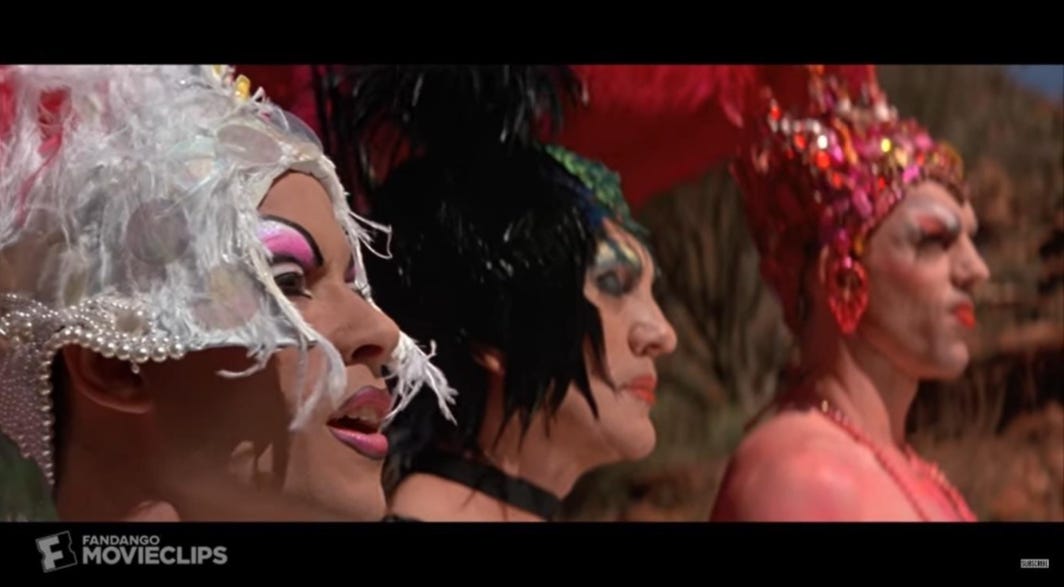
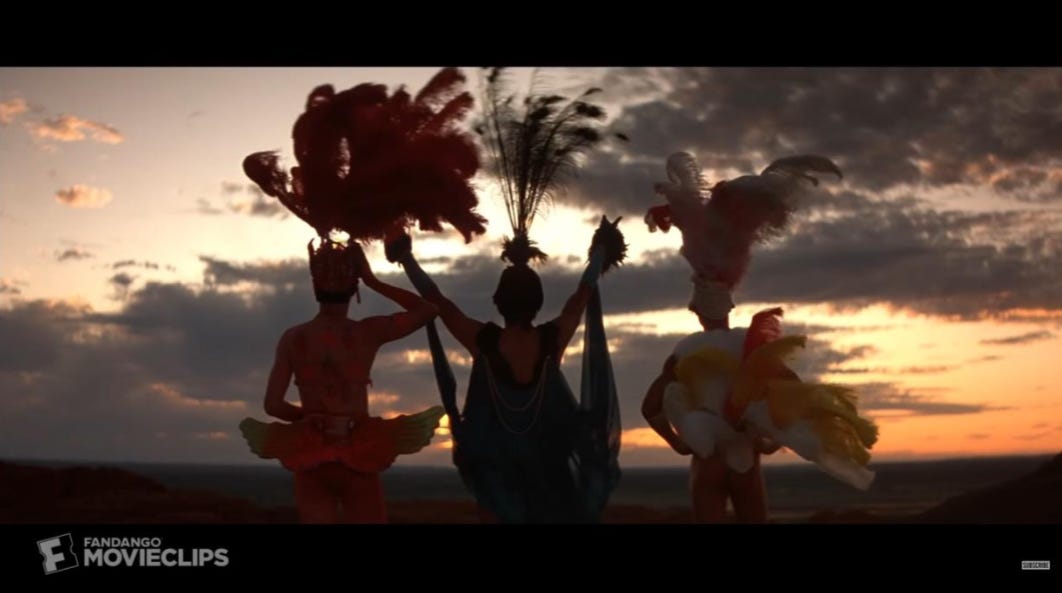
During the mountaintop scene47 of Priscilla Queen of The Desert,48 the only words spoken are at the 49beginning; “I had a dream”50, then the score “The Climb”51 engulfs us till the three drag queens have soaked in the view of The Kings Canyon, standing right on the edge of the cliff, the whisper of a “fall” not occurring one to their minds. After being surrounded by the beige outback for most of the movie the only bright colours being the outfits, there seems to evolve an equilibrium between dull 52and the bright. Both are necessary for the drag queens to grow and learn.
46 [Figure 6] MovieClips. The Adventures of Priscilla, Queen of the Desert (1994) - The Mountain Top Scene. Youtube. 2019.(Accessed 13/04/2023) – [0:03]
47 MovieClips. The Adventures of Priscilla, Queen of the Desert (1994) - The Mountain Top Scene. Youtube. 2019.(Accessed 13/04/2023)
48 Elliott, Stephen. Priscilla Queen of The Desert. Polygram Film Entertainment. 1994
49 [Figure 7] MovieClips. The Adventures of Priscilla, Queen of the Desert (1994) - The Mountain Top Scene. Youtube. 2019. (Accessed 13/04/2023) – [0:34]
50 MovieClips. The Adventures of Priscilla, Queen of the Desert (1994) - The Mountain Top Scene. – [0:02) 51 Gross, Guy. Music from “The Adventures of Priscilla, Queen of the Desert (1994)”. https://www.soundtrack.net/album/the-adventures-of-priscilla-queen-of-the-desert-score/. (Accessed 01/05/2023)
The trials of a monochrome environment are just as important as the dreams of our colourful spectacles. Completely opposite to Dorothy in The Wizard of Oz,53 where she “falls” into colour and 54then must ‘leave” colour at the end, in Priscilla, we learn that colour is everywhere and it’s the one thing that can enrich us. Whether it be dry winds lifting orange polyester into a brilliant spiral55 or a dream to climb a mountain in full drag, we must coexist with colour.
56
To coexist with colour, we must learn that we don’t see its reality. That is hidden from us by “colour consistency”,57 without it, imagine a world constantly moving, objects being rebuilt, deconstructed, colours changing with every light ray hitting a surface, sandwiched between milliseconds of
53 Baum, L. Frank, and Michael Foreman. The Wonderful Wizard of Oz. Centenary ed. London: Pavilion, 1999. 54 [Figure 8] Three Dollar Bill Cinema, Road Trip! THE ADVENTURES OF PRISCILLA, QUEEN OF THE DESERT, Screenshot of [2:09], (Accessed 30/04/2023).
55 Three Dollar Bill Cinema. Road Trip! THE ADVENTURES OF PRISCILLA, QUEEN OF THE DESERT. 2013.(Accessed 30/04/2023) – [2:06]
56 [Figure 9] MovieClips. The Adventures of Priscilla, Queen of the Desert (1994) - The Mountain Top Scene. Youtube. 2019. (Accessed 13/04/2023) – [1:41]
57 Batchelor, David. The Chromatic Ecology of Munchkin Land – [Page 5]
complete darkness. Completely the opposite of “white torture”58 where you are inside a white room wearing white clothes, eating white food, completely soundproofed. Both are maddening.
59
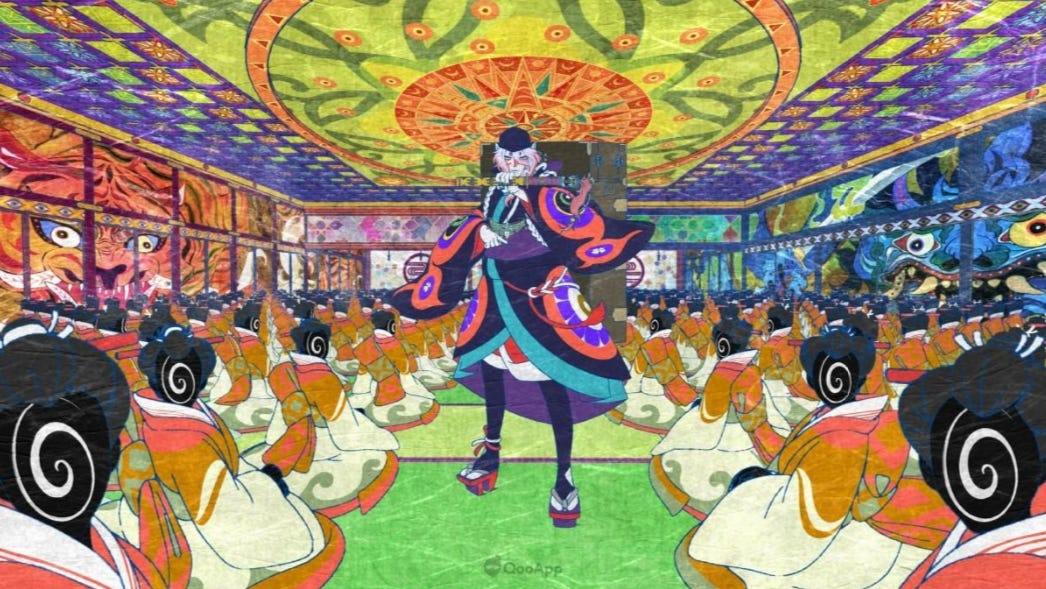
Mononoke,60 an animated series that is reminiscent of this colourful fever dream shows how this is no novelty to the characters. Even the lack of a linear plot goes hand in hand with the chaotic unexplained colour. I like to think this is how Dorothy viewed Oz when she first arrived. I am alienated, despite recognising all the colours. I am just as alien as the “outer space”61 drag queens crash landing into Australia’s outback. In “The Zahiki Warashi” episode of Mononoke we do not fall into colour, we are birthed into colour.
58 Newton, Paula. CNN. Iranian exile speaks out on colourless ‘white torture. 29/10/2008.http://edition.cnn.com/2008/WORLD/asiapcf/10/29/amir.fakhravar.iran.torture/ (Accessed 18/04/2023)
59 [Figure 10] J. Konaka, Chiaki, Nakamura, Kenji. Mononoke. Toei Animation. Aired 12/07/2007. Frame of animation.
60 J. Konaka, Chiaki, Nakamura, Kenji. Mononoke. Toei Animation. Aired 12/07/2007.
61 Gaynor, Gloria. I will Survive. Love Tracks. 1978
62
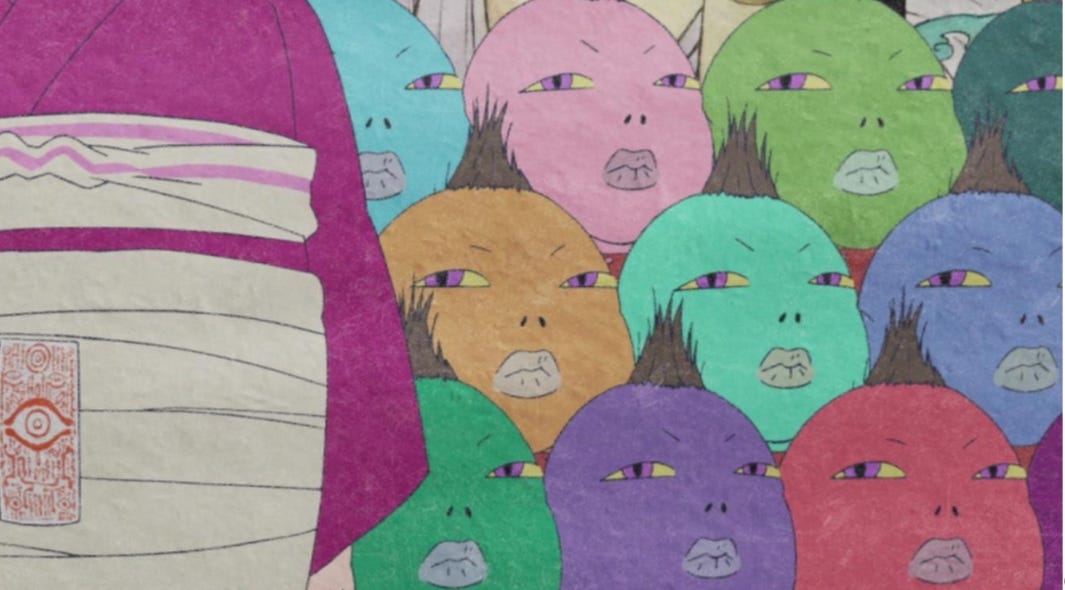
Confronted by the spirits of unborn children whose graves lie in the walls of a brothel as they search for a pregnant body to be born via. One of the children is a bright red baby, reminiscing the ‘The innermost deity [...] the Red Child (Chizi)’63 in The Golden Elixir64. In this artwork, there is an emphasis on the burden of birthing your child into the human perspective, and how we cannot understand the “thousand[s] of things”65 that exist. The characters view colour as secondary, and yet it is the one thing the audience first notices. This is happening to our world, juxtaposing with everything turning black and white, we could be born into the most vibrant world but because we’re born into it, we don’t notice it. My question and concern now is; when will we stop? If we created a completely black-and-white world, you would learn your favourite shade of grey, someone would disagree and the whole cycle would repeat just as it is with colour. Humanity is only satisfied when we can prove something, we take advantage until we no longer see the luxury of being born into
62 [Figure 11] Mononoke, Anime Book Club – Mononoke Week 2: Zashikiwarashi, 2018, Frame of Episode 2, https://www.s1e1.com/2018/09/03/anime-book-club-mononoke-week-2-zashikiwarashi/ (Accessed 01/05/2023)
63 Pregadio, Fabrizio. The Golden Elixir. 2008 – [Page 15]
64 Pregadio, Fabrizio. The Golden Elixir. Jindan. The Encyclopedia of Taoism, Vol. 1, pp 551-55, Routledge. 2008. https://goldenelixir.com/publications/eot_jindan.html. (Accessed 20/04/2023)
65 Laozi. Dao De Jing. 1989 translation – [Page 1, Passage 1]
66
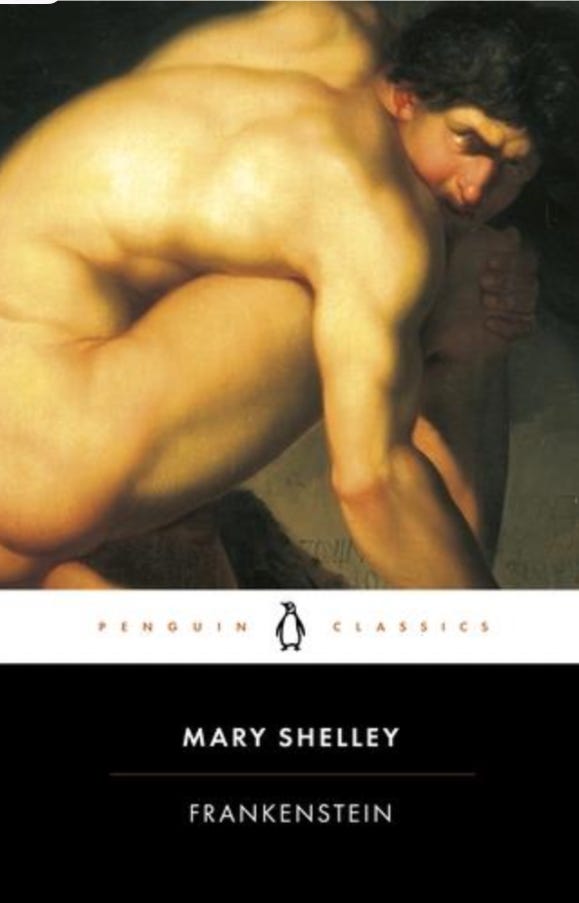
colour as anything but terrifying. When Frankenstein67 birthed68 the “Creature” under the “dim and yellow light of the moon”69 his desire to “penetrate into the recesses of nature”70 clouded over with the fear of when we are punished for assuming nature’s role. From an Aristotelean perspective, light from the moon is impure as it is being reflected. Defiled light71 blankets the creature’s “watery eyes”, “dun white sockets” and “pearly” teeth,72 humanity only fools itself into believing its superiority. Everything we believe is beautiful will turn ugly if humanity is given long enough to fight over what is superior
As we are ‘born into colour’ humanity cannot truly experience its marvel. I don’t think there is a way for colour to be what humanity wants it to be. If we cannot accept that it will be a disaster. We would be united by how our monochrome lives, like photographs, symbolise a collective experience – a “concept”.73 We would be expendable, more so than the current life cycle of humanity: be born, go to work and then die. However, we can avoid this by listening to Jarman, the Queens in Priscilla
66 [Figure 12] Shelley, Mary Wollstonecraft, and Maurice Hindle. "Frankenstein or the Modern Prometheus." Rev. ed. London: Penguin Books, 2003. Cover of Book ver.
67 Shelley, Mary Wollstonecraft, and Maurice Hindle. "Frankenstein or the Modern Prometheus." Rev. ed. London: Penguin Books, 2003.
68 Shelly, Mary Wollstonecraft. Frankenstein. 2003 – [Page 58]
69 Shelly, Mary Wollstonecraft. Frankenstein. 2003 – [Page 59]
70 Shelly, Mary Wollstonecraft. Frankenstein. 2003 – [Page 49]
71 Melville, Herman. Moby dick. The Whiteness of The Whale – [Page 186] 72 Shelly, Mary Wollstonecraft. Frankenstein. 2003 – [Page 58]
73 Flusser, Vilem. Towards a Philosophy of Photography. London: Reaktion, 2005. – [Page 18]
and the Dao de Jing, they understand our inescapable human perspective and the reality of what colour actually is, both are as real as each other. There is beauty in never being able to truly understand something, we have to understand that the academic mind isn’t superior. Accepting, interacting, and listening to the world is how we coexist with colour. The more obsessed with finding a purpose and legacy the more we drive ourselves into a corner. Sit and learn from colour, let the ‘inanimate’ talk to us instead of us talking about it and I believe the world will be richer. Those who believe that black and white as non-colours are superior to colour are tunnelling into the cave of hermits. Once you enter, you segregate yourself and you may not come back. In the words of Laozi; “do you think could take the universe and improve it?”;74 “Empty yourself of everything. Let the mind become still. The ten thousand things rise and fall while the Self watched their return.”75
74 Laozi. Dao De Jing. 1989 translation – [Page 9, Passage 29] 75 Laozi. Dao De Jing. 1989 translation – [Page 5, Passage 16]
Bibliography
Primary:
1. Batchelor, David. The Chromatic Ecology of Munchkin Land. ((1st year lecture, adapted from Professorial Inaugural Lecture, Goldsmiths’ College, 25.02.19). [Accessed 12/04/2023]
2. Elliott, Stephen. Priscilla Queen of The Desert. Polygram Film Entertainment. 1994
3. J. Konaka, Chiaki, Nakamura, Kenji. Mononoke. Toei Animation. Aired 12/07/2007.
4. Jarman, Derek. Blue. Basilisk Communications/Uplink, 1993.
5. Somerset House. The Horror Show! A twisted Tale of Modern Britain. 27 October 2022 - 19
February 2023. Embankment Galleries, Somerset House. Somerset house.org. https://www.somersethouse.org.uk/press/horror-show-twisted-tale-modern-britain. (Accessed 23/04/2023)
6. Laozi, Feng, Gia-Fu & Jane English, trans. Dao De Jing. New York, NY: Vintage Books, 1989. http://www2.hawaii.edu/~freeman/courses/phil394/Daodejing.pdf.
(Accessed 14/04/2023)
7. Shelley, Mary Wollstonecraft, and Maurice Hindle. Frankenstein or the Modern Prometheus. Rev. ed. London: Penguin Books, 2003.
Secondary
8. A Mushishi Blog, Parablesoftheone:. Daoist transcendental meditiation in “Light of the Eyelid”. 2 years ago. https://parablesoftheone.tumblr.com/post/638689993558294528/daoist-transcendental- meditation-in-light-of-the. (Accessed 20/04/2023)
9. Atwood, Margaret. The Handmaid’s Tale. Vintage, 2017.
10. Batchelor, David. Chromophobia. Focus on Contemporary Issues. London: Reaktion, 2000.
(Accessed 12/04/2023)
11. Baum, L. Frank, and Michael Foreman. The Wonderful Wizard of Oz. Centenary ed. London: Pavilion, 1999.
12. Brown, Jack Perry. "Finlay, Victoria. Color: A Natural History of the Palette." Library Journal 128, no. 2 (2003): 82.
13. Dickins, Bruce, and Alan Strode Campbell Ross. The Dream of the Rood 4th Ed; Reprinted with Further Additions and Corrections.. ed. Methuen's Old English Library. [A. Poetic Texts ; 4]. London: Metheun, 1963.
14. Evans, Gavin. "Deliver Us from Venus and Mars." New Internationalist, no. 505 (2017): 32.
15. Falcinelli, Riccardo. Chromarama, How Colour Changed Our Way of Seeing. Particular Books.
3/11/2022. (Accessed: 23/04/2023)
16. Fleming, Victor, Noel Langley, and Frank L. Baum. Wizard of Oz. MGM, 1939.
17. Flusser, Vilem. Towards a Philosophy of Photography. London: Reaktion, 2005.
18. Gibert, Teresa. "Margaret Atwood’s Visions and Revisions of "The Wizard of Oz"." Journal of
English Studies (Logroño) 17, no. 17 (2019): 175-95.
19. Gross, Guy. Music from The Adventures of Priscilla, Queen of the Desert (1994).
https://www.soundtrack.net/album/the-adventures-of-priscilla-queen-of-the-desert-score/.
(Accessed 01/05/2023)
20. Hendrischke, Barbara. The Seal of the Unity of the Three. A Study and Translation of the
Cantong Qi, the Source of the Taoist Way of the Golden Elixir. By Fabrizio Pregadio. Mountain View, CA: Golden Elixir Press, 2011. Pp. Xiii 308. Paper, $24.95." Religious Studies Review 38, no. 4 (2012): 259.
21. Homer. The Odyssey. Translated by Robert Fagles. Boyle.Kyschools.https://www.boyle.kyschools.us/UserFiles/88/The%20Odyssey.pdf (Accessed 01/05/2023)
22. Huxley, Aldous. The Doors of Perception And, Heaven and Hell. Vintage Classics. London: Vintage, 2004.
23. Jennings, Carl. Chromophobia: Men In Black - The Fear of Colour in Western Culture. Medium. 05/25/2019. https://medium.com/swlh/men-in-black-the-fear-of-color-in- western-culture-33e42a5e92c2. (Accessed 15/04/2023)
24. Johns, Alessa, Bluestocking Studies 2011-2017: The Transnational Turn. Literature Compass. Volume 14, Issue 11. 06/08/2017. https://compass-onlinelibrary-wiley- com.gold.idm.oclc.org/doi/full/10.1111/lic3.12426. (Accessed 10/04/2023)
25. Klincewicz, Julian. Pure Michigan. Spotify.2022.
26. Linkin, Harriet Kramer. "Romanticism and Mary Tighe's Psyche: Peering at the Hem of Her
Blue Stockings." Studies in Romanticism 35, no. 1 (1996): 55.
27. Melville, Herman. Moby Dick. Anaheim, CA: Cyber Classics. (Accessed: 16/04/2023)
28. Mononokehunters. Interview with Kenji Nakamura and Koji Yamamokto on the upcoming
Mononoke Movie. Tumblr. 14/07/2022. https://mononokehunters.tumblr.com/post/689777447906017280/interview-with-kenji- nakamura-and-koji-yamamoto-on. (Accessed 19/04/2023)
29. MovieClips. The Adventures of Priscilla, Queen of the Desert (1994) - The Mountain Top Scene. Youtube. 2019.
(Accessed 13/04/2023)
30. Poole, Ralph J. “Rise Like Two Angels in the Night:” Sexualized Violence Against Queers in American Film." European Journal of American Studies 13, no. 4 (2018). doi:https://doi.org/10.4000/ejas.14078. https://gold.idm.oclc.org/login?url=https://www.proquest.com/scholarly-journals/rise-like- two-angels-night-sexualized-violence/docview/2407587069/se-2.
31. Pregadio, Fabrizio, The Way of The Golden Elixir, And introduction to Taoist Alchemy. Golden Elixir Press. Mountain Veiw, CA. Third Edition (2019).
32. Pregadio, Fabrizio. The Golden Elixir. Jindan. The Encyclopedia of Taoism, Vol. 1, pp 551-55, Routledge. 2008. https://goldenelixir.com/publications/eot_jindan.html. (Accessed 20/04/2023)
33. Proyas, Alex. Dark City. Mystery Clock; New Line Cinema, 1998.
34. Reynolds, Joshua. Morley, Henry. The Project Gutenberg eBook, Seven Discourses on Art, by
Joshua Reynolds. Transcribed from the 1901 Cassell and Company edition by David Price.
eBook #2176. 08/05/2005. (Accessed 02/05/2023)
35. Richard D. Lewis. Monochromatic and Polychromatic Cultures. 21/01/2013.
https://www.crossculture.com/monochromatic-and-polychromatic-cultures/. (Accessed
18/04/2023)
36. Robin W Kimmerer. Braiding Sweetgrass: Indigenous Wisdom, Scientific Knowledge and the
Teaching of Plants. (London: Penguin Books, 2020). 389. 2013.
37. Roland, Barthes. The Responsibility of Forms Critical Essays on Music Art And
Representation. Hall and Wang, a division of Farrar, Status and Giroux, Inc. Academia edu. 1991. https://www.academia.edu/32031590/Barthes_Roland_The_Responsibility_of_Forms_Critic al_Essays_on_Music_Art_And_Representation. (Accessed 12/04/2023
38. Royal Academy. Studio Experiments in Colour and Media, Sir Joshua Reynolds PRA (1723- 1792). Ra Collection: Art. https://www.royalacademy.org.uk/art-artists/work-of-art/studio- experiments-in-colour-and-media. (Accessed 17/04/2023)
39. Sir Joshua Reynolds. Discourses on Art. Edited with notes and an historical and biographical introduction by Edward Gilpin Johnson. Chicago, A.c. McClug and Company 1891.
40. The Bible, Proverbs, Chapter 23, verse 31. BibleHub. https://biblehub.com/proverbs/23- 31.htm. (Accessed 25/04/2023)
41. Three Dollar Bill Cinema. Road Trip! THE ADVENTURES OF PRISCILLA, QUEEN OF THE DESERT. 2013.
(Accessed 30/04/2023)
42. Warrell, Ian. "The Secret Lives of Colour." Country Life (London), 2017, 90.
43. Newton, Paula. CNN. Iranian exile speaks out on colourless ‘white torture.' 29/10/2008.
http://edition.cnn.com/2008/WORLD/asiapcf/10/29/amir.fakhravar.iran.torture/ (Accessed
18/04/2023)
44. Wichmann, Anna. Did the Ancient Greeks See Blue Like We Do? GreekReporter. 25/04/2023.
https://greekreporter.com/2023/04/25/did-ancient-greeks-see- blue/#:~:text=Linguists%20argue%20that%20ancient%20Greeks,exactly%20they%20perceiv ed%20the%20hue. (Accessed: 25/04/2023)
45. Witcher, Robert. Durham. The Wizard of OZ. Antiquity Publications LTD, 01/04/2019. (Accessed 14/04/2023)
46. Wu, Duncan. "Romanticism an Anthology. The Marriage of Heaven and Hell | William Blake." 4th ed. Blackwell Anthologies. Chichester, West Sussex : Malden, MA: John Wiley & Sons, 2012. (Accessed 01/05/2023)